Will Future Generations Look Back at How We Treated Children With Learning Difficulties?
Recently, I came across an Instagram carousel that compared some of the things we now look back on in disbelief, such as corporal punishment in schools, with practices that are still accepted in education today (see link below for this post).
The post asked what future generations might think when they look back at the way we currently educate children.
It really resonated with me because, after almost 30 years of working with children, particularly children with dyslexia, language difficulties, ADHD and other learning differences, I often wonder the same thing.
Will people look back and question why we continued to ask children to complete tasks that we knew were incredibly difficult, or even impossible, for them?
Will they understand why technology was sometimes treated as an unfair advantage rather than a reasonable adjustment?
Will they wonder why children often had to fall so far behind before they could access support?
And will they understand why distress was so often seen as poor behaviour, rather than a sign that a child was overwhelmed or struggling to cope?
I do want to say that I have definitely seen things changing. Many of the teachers I work with are very keen to do the best they can for their students. They care deeply, they want to understand, and they are often doing everything they can within a system that is under-resourced, stretched and still slow to change.
This is not about teachers not wanting to support children. It is about a system that can make it very difficult for them to do so.
When difficulty is mistaken for a lack of effort
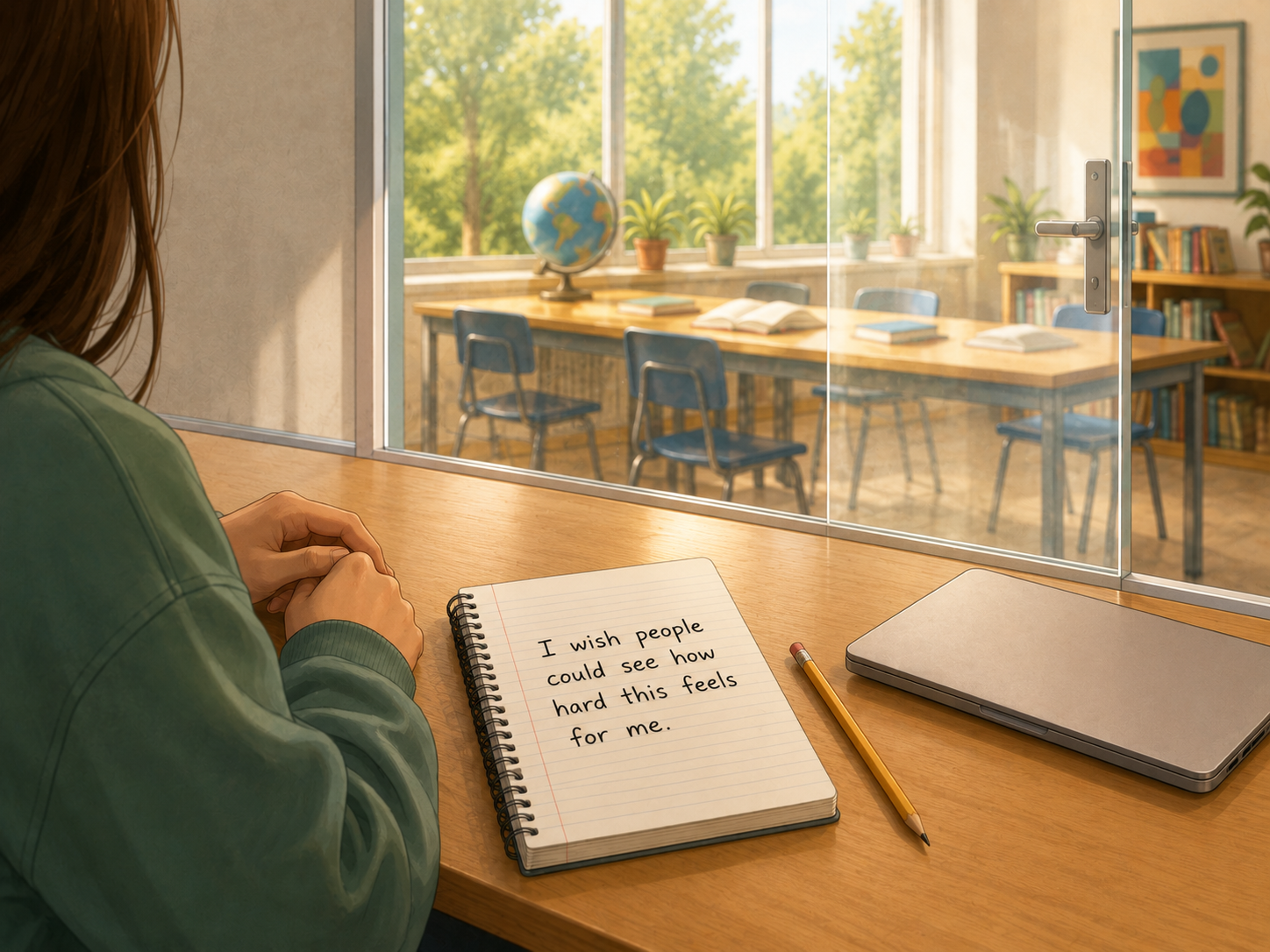
Many of the children I work with are trying much harder than anyone realises.
A child with dyslexia may use an enormous amount of mental effort to read a short passage that another child reads automatically. A student with language difficulties may understand the topic but struggle to find the words to explain what they know. A child with ADHD may know what they need to do but find it very difficult to start, organise themselves or keep going.
From the outside, this can look like avoidance, carelessness, poor motivation or a lack of effort. Children are told to concentrate, slow down, try harder, check their work or take more care.
But often, effort is not the problem.
The task may be placing demands on skills that are not yet developed, or the child may be expected to show what they know in a way that creates an unnecessary barrier. When this happens over and over again, children start to make sense of it in the only way they know how.
They do not think, “I have difficulty with phonological processing, working memory or language.”
They think:
“I’m stupid.”
“I’m bad at school.”
“Everyone else can do this except me.”
“There’s no point trying because I’ll still get it wrong.”
These beliefs can become deeply ingrained.
Emotional wellbeing is part of learning
One of the main messages in the Instagram post was that emotional wellbeing should not be treated as separate from learning.
I see this so often in my work. A child who feels ashamed, anxious or constantly worried about making a mistake is not in the best position to learn.
When children are repeatedly asked to read aloud in front of their peers, copy large amounts of information from the board, complete timed tasks or write independently without enough support, it is not surprising when they begin to avoid those situations.
Avoidance is often protective.
Refusal may mean, “This is too hard.”
Perfectionism may come from a fear of making mistakes.
Clowning around may be a way of shifting attention away from a task the child cannot complete.
Frequent trips to the bathroom, headaches, tears, anger or shutting down may all be signs of distress.
Of course, children still need boundaries, expectations and opportunities to develop resilience.
But resilience is not built by repeatedly placing a child in a situation where they are likely to fail.
It is built when children are given challenges they can manage, feel safe enough to make mistakes and know that the adults around them understand what they need.
Equal treatment is not always fair treatment
Many families I work with still come up against resistance when they ask for reasonable adjustments.
They may be told that allowing a laptop would not be fair to the other students.
That speech-to-text gives the child an advantage.
That listening to an audiobook is not really reading.
That using a scribe will stop the child from learning to write.
That assistive technology should only be used once the child has tried harder without it.
But this misunderstands what an adjustment is for.
A laptop does not remove the need to teach spelling and writing.
Speech-to-text does not replace explicit language and literacy intervention.
Text-to-speech does not replace reading instruction.
These tools allow a student to access learning while those underlying skills are still developing. We can build skills and remove barriers at the same time.
A child who cannot independently read a Year 7 science textbook still deserves access to Year 7 science.
A child whose handwriting is slow, painful or difficult to read still deserves to express complex ideas.
A student who cannot accurately decode an exam question still deserves the opportunity to show what they know about the subject.
Providing access is not lowering expectations. It is removing the barrier that is getting in the way of the child demonstrating their actual knowledge.
Why do children have to prove how much they are struggling?
Parents regularly tell me that they raised concerns years earlier. They noticed that their child was not learning letter sounds, could not blend words, forgot spelling patterns, struggled to remember instructions or became very distressed about school. They were often reassured that their child would catch up.
That they were still young.
That boys develop later.
That more reading at home would help.
That the child just needed more confidence.
Sometimes children do catch up. But when the difficulty is persistent, waiting can come at a very high cost. By the time many children come to see me, literacy is no longer the only concern. There may also be anxiety, school refusal, perfectionism, anger, exhaustion, low confidence or a strong belief that they are not intelligent.
Early identification does not mean placing a limiting label on a child. It means noticing risk, understanding what is happening and putting the right support in place before the child has experienced years of failure.
A child should not have to be significantly behind or emotionally overwhelmed before their difficulties are taken seriously.
Children should not have to earn access through failure
There can still be a belief that accommodations should only be introduced once a child has shown that they cannot cope without them. Some people worry that providing support too early will make the child dependent, reduce motivation or prevent them from developing skills. But children do not become independent by being denied the tools they need.
They become independent when they understand how they learn, know what creates barriers for them and are able to use strategies and technology that help.
A child using text-to-speech is learning how to access information.
A student who dictates a first draft and then edits it is still developing written expression.
A child who types rather than handwriting every task may have much more capacity available for organising ideas, choosing vocabulary and constructing sentences.
Independence does not mean doing everything without support. It means understanding what support is needed and being able to use it well.
What might future generations question?
Perhaps they will question why we placed so much importance on children appearing to cope.
Why neat handwriting sometimes mattered more than the quality of a child’s ideas.
Why speed was so often treated as a measure of ability.
Why children were praised for quietly struggling but seen as difficult when they finally expressed their distress.
Why all children were expected to show their learning in the same way.
Why access to reasonable adjustments depended so much on the understanding, beliefs or resources of an individual teacher or school.
And why, despite knowing so much about dyslexia, ADHD, language difficulties, cognitive load and emotional wellbeing, our education system was still so often built around the expectation that children should all learn and perform in similar ways.
The system needs to make it easier to do the right thing
I have worked with many wonderful teachers who genuinely want to support their students. They are often open to learning, keen to put recommendations in place and deeply concerned about the wellbeing of the children in their classroom. But they are also working in a system where classes are large, time is limited, access to specialist support can be difficult and policies are not always clear or consistently applied.
Teachers should not have to fight the system to provide a child with a laptop, text-to-speech or a different way to demonstrate their learning.
Parents should not have to repeatedly prove that their child is struggling.
Children should not have to fail for years before the right support is put in place.
We already know enough to make changes.
We can listen when children and parents say that something is not working.
We can investigate persistent difficulties rather than continuing to wait.
We can provide explicit, evidence-based intervention while also making sure children can access classroom learning.
We can introduce assistive technology before a child loses confidence.
We can respond to behaviour with curiosity and ask what the child may be communicating.
We can recognise that emotional safety is not separate from learning. It is one of the things that makes learning possible.
Most importantly, we can stop requiring children to repeatedly demonstrate how much they are struggling before offering them another way forward.
My hope is that future generations will look back and see this as the time when we started listening more carefully, questioning old assumptions and making meaningful changes.
Children should not have to sacrifice their confidence, wellbeing or sense of self in order to receive an education.
This is the Instagram post that inspired me.